European gas storage has fallen sharply since the start of the heating season, with the growing deficit likely to drive record LNG imports and intense summer refilling in 2026.
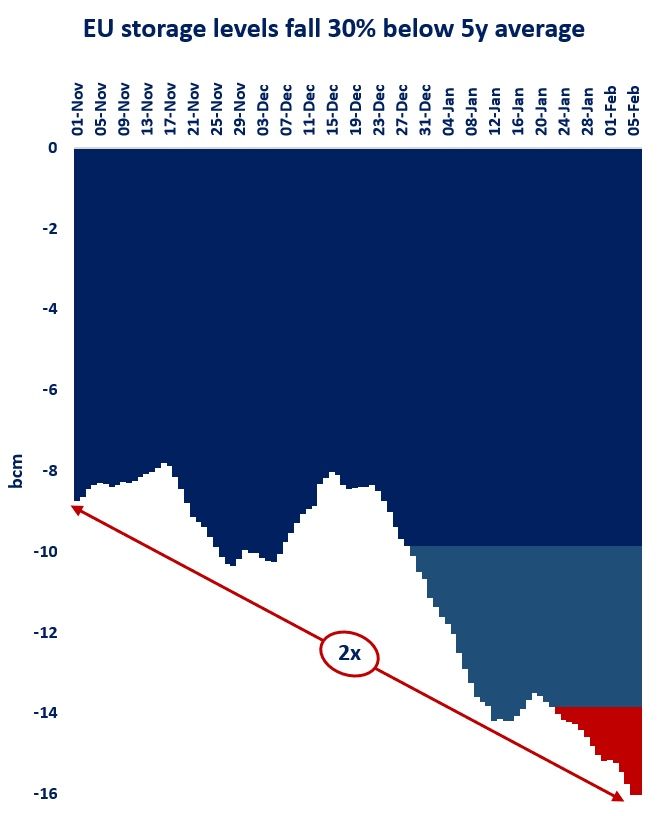
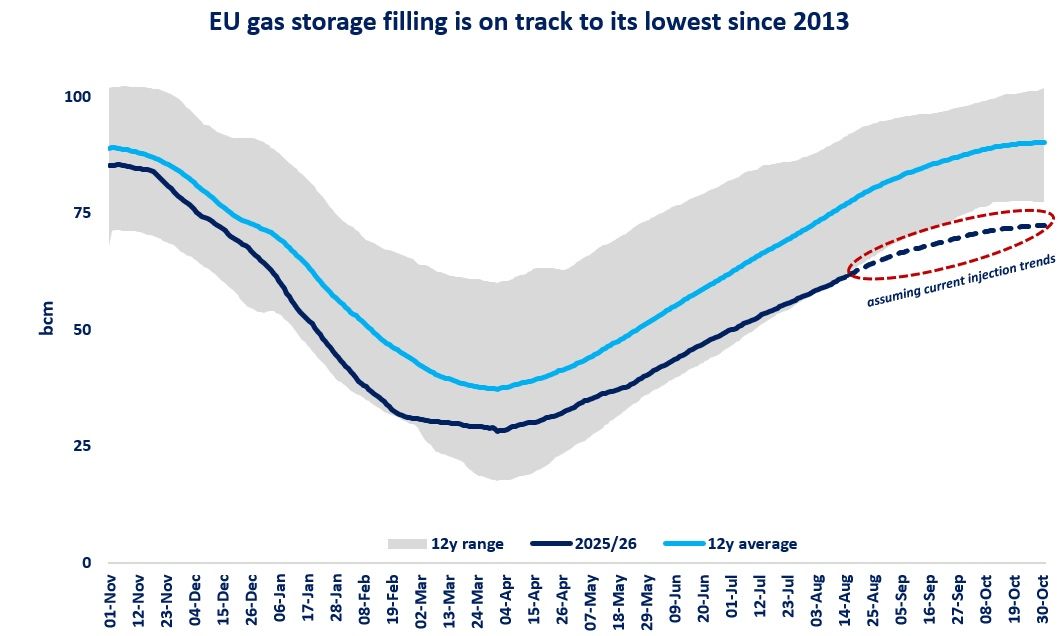
The EU’s 5Y storage deficit doubled since the start of the heating season to 16 bcm, with inventory levels now standing 30% below their 5Y average. These lower storage levels are set to boost Europe’s LNG imports to a new record high in 2026.
The EU started the 2025/26 heating season with inventories significantly lower than in previous years, with storage sites filled up to just over 80% of their working capacity and inventories standing 8 bcm below their 5Y average at the beginning of November.
The 5Y storage deficit remained within the 8–10 bcm range until the end of 2025, but withdrawals steeply accelerated since the start of January and rapidly deteriorated the EU’s storage position.
Colder weather, together with higher gas burn in the power sector, boosted Europe’s gas demand by nearly 7% (or 4 bcm) YoY since the start of the year, while much-needed piped gas exports to Ukraine rose by more than tenfold (or almost 0.9 bcm).
This strong increase in demand drove up storage withdrawals, soaring by almost 25% compared to their 5Y average since the start of 2026.
Consequently, the EU’s storage deficit doubled compared to November, rising to just over 16 bcm by the beginning of February. EU storage fill levels dropped to just 37%, while in Northwest Europe they are now trending below 30% (the Netherlands at 20%, while France and Germany at 27%).
Assuming that storage withdrawals would continue at their 5Y average, EU storage sites could finish the heating season just 25% full — their lowest level since the 2017–18 winter, when the infamous Beast from the East depleted storage sites to a dangerous level.
These low storage levels will drive strong injections over the summer of 2026, likely boosting Europe’s LNG imports to a new record high in 2026 — in line with our latest forecast.
Flexible LNG supplies, including from the US, will be once again crucial to refill EU storage sites to adequate levels. Strong injection needs will in turn provide a floor to summer gas prices, especially if there is a revival in Asia’s gas demand.
What is your view? Where do you see EU storage levels at the end of March? How will the summer market play out? What does it mean for price levels?
Source: Greg MOLNAR