The PSV gas hub reflects Italy’s uniquely complex supply and demand structure, making it one of Europe’s most dynamic gas markets.
Among key European gas markets, PSV is the one that stands out. Were there a competition for the title of the most dynamic gas hub, it would be crowned most of times.
Bearing in mind that the price is a reflection of supply/demand interactions (with all buts and ifs, and country-specific nuances), the way PSV behaves itself is perfectly illustrating the features of the Italian gas market.
Together with Germany and UK, Italy is among Europe’s top gas consumers which makes the country’s balance particularly exposed to swings in demand.
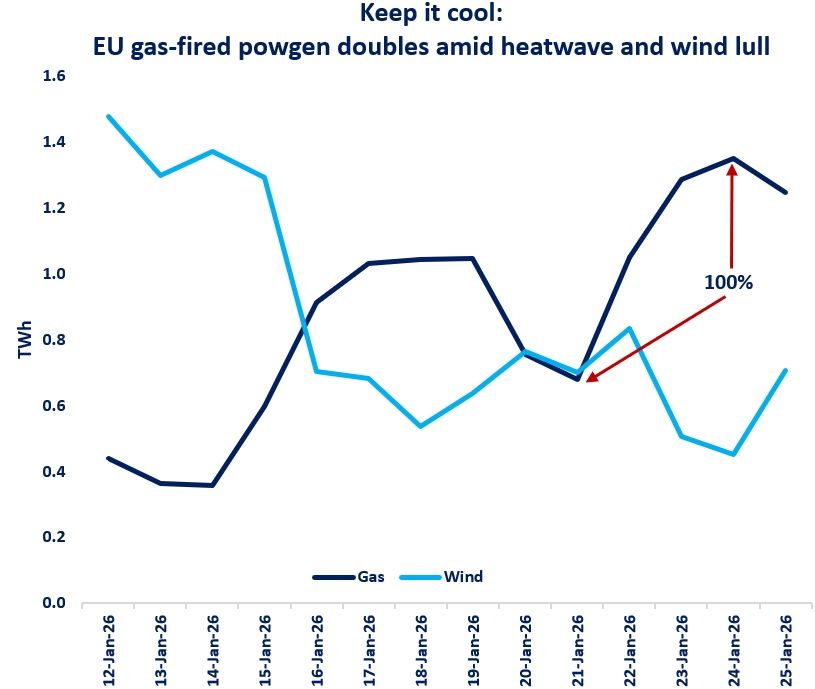
But in contrast to the first two, PSV carries a double-peaked demand exposure. Stronger consumption manifests itself across the Apennine Peninsula not only in winter, but also mid-summer when the country ramps up air conditioning to escape another heatwave.
Supply-wise, the Italian market has gone through a transformation over the past few years. There is no more Russian gas with lots of volume flex incorporated in LTAs that had acted as a sort of release valve for the system.
The role of Algerian gas has naturally increased for Italy with all the ‘funny’ moments arising from that. And LNG, in the Italian context especially, is just of a different nature in terms of its ability to help supply meet consumption.
Next in line is storage, a variable that in other more relaxed regulatory environments could be a game changer for supply/demand equation and thus price on the hub (again, with all buts and ifs). In Italy, it is different though as a storage component is strictly regulated, allowing to pull the time spreads lever for balancing the market only to a certain extent.
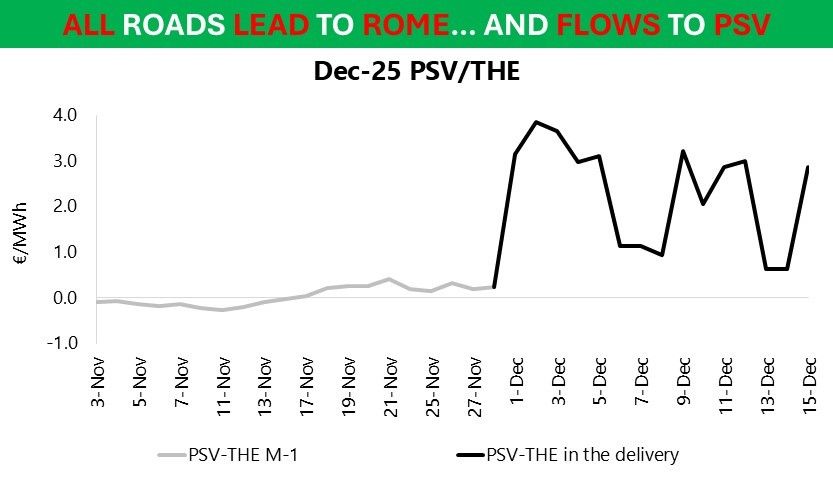
Beyond that, a geographical differentials dimension is at your disposal with all that this entails. In fact, PSV dynamics this December is a textbook example of how it works in Italy.
Amid the end of Russia/Ukraine gas transit, one more layer has been added to the mechanics of PSV price formation this year.
As a logical consequence of the development, the interdependence between the Italian PSV gas hub and VTP (and through it a wider CEE region) has got to a new level.
Given such a multi-layered structure of the Italian market, curious to see if the PSV-TTF initiative would take into account the abovementioned ‘momenti’.
Source: Yakov Grabar