A historic decision: the European Union reached overnight an agreement on the legally binding phase-out of Russian gas, ending more than five decades of reliance on gas from Russia.
The first molecules of Siberian gas reached Western Europe back in 1968, when first gas was delivered to Austria’s Baumgarten. This was followed in 1970 by the historic gas deal between the Soviet Union and West Germany.
The 20-year contract included some barter elements, including “pipes for gas”, and practically paved the way for the decades-long gas relationship between Europe and Russia.
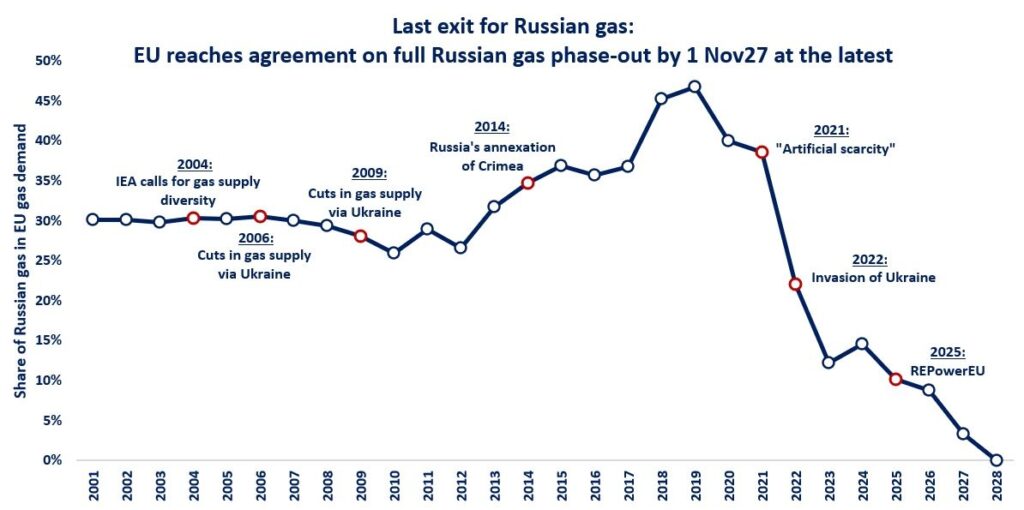
The EU’s reliance on Russian gas grew gradually. Russian gas met around 30% of the EU’s gas demand in the early 2000s. What is quite astonishing to see is that this dependence grew significantly after the annexation of Crimea, with Russia meeting almost half of the EU’s gas demand in 2019.
There are three key steps in the Russian gas phase-out plan:
Short-term LNG and piped contracts will be banned by April and June 2026 respectively;
Russian LNG imports will be banned by 1 January 2027;
Russian piped gas deliveries will be banned by 1 November 2027 at the very latest.
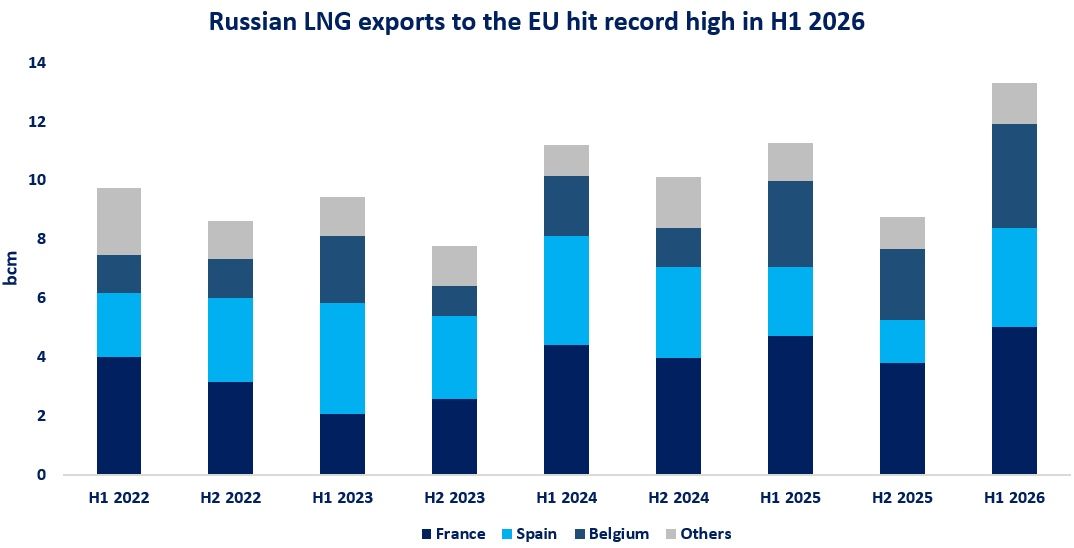
The EU is on track to import around 20 bcm of Russian LNG in 2025, largely concentrated in Northwest and Southwest Europe. While some of those volumes could be rerouted to other markets, shipping logistics might be a constraint, especially when considering the EU’s transhipment ban.
The EU is expected to import around 14 bcm of piped gas from Russia this year, with around 10.5 bcm under long-term contracts.
The phase-out of Russian gas creates additional market space for alternative suppliers, including the United States, which played a key role in stabilising the European market through the 2022/23 gas crisis.
There are also question marks:
(1) what will be the implication of Russian gas transit via the European Union to other countries (including Serbia);
(2) how will the guarantee of origin mechanism be established;
(3) could certain EU Member States dispute the decision;
(4) what will be the legal consequences in relation to long-term contracts – can force majeure clauses be triggered?
What is your view? Are we entering a new phase of the EU gas market?
Source: Greg MOLNAR